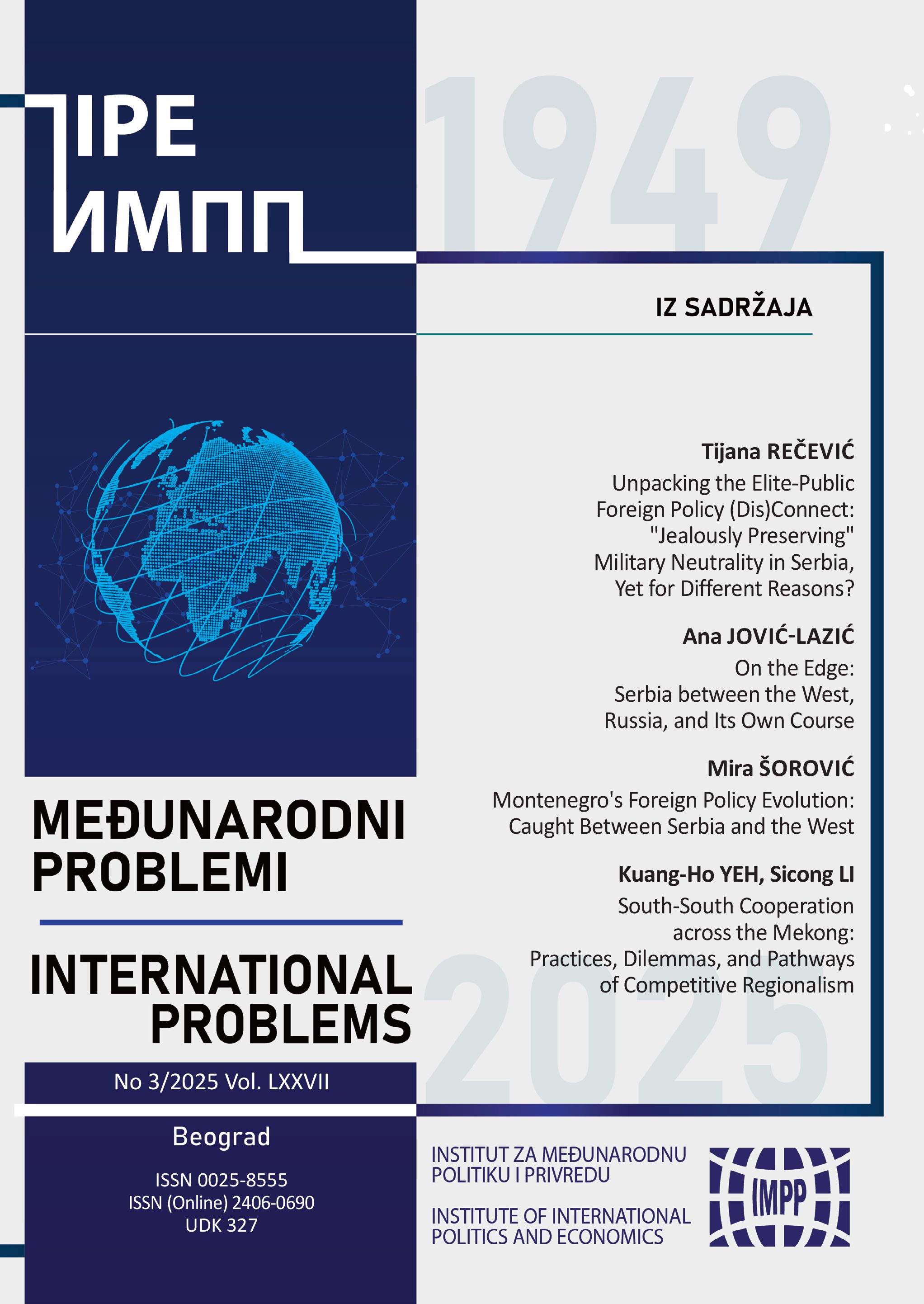
Public opinion on foreign policy was for decades largely dismissed in international relations and foreign policy studies, typically under the assumption that it merely mirrored elite preferences. Subsequent scholarship, however, has challenged this view by documenting numerous instances of “foreign policy disconnects”, showing that public and elite attitudes diverge more frequently and persistently than initially assumed, with significant implications for policymaking. Distinguishing between preference-level (mis)alignment, understood as support for or opposition to a given policy, and belief-level (mis)alignment, which captures the reasoning behind such positions, this article seeks to unpack these disconnects, enabling a more nuanced understanding of the elite–public nexus in foreign policy. On this basis, it introduces a novel matrix of foreign policy (dis)connects, yielding four ideal types: full connect, divergent connect, convergent disconnect, and full disconnect. The framework is applied to the case of Serbia’s military neutrality, often portrayed as a stable consensus between policymakers and the public within Serbia’s multi-vector foreign and security policy. Drawing on discourse analysis of Serbia’s strategic framework since 2007 and original 2023 survey data, the article shows that while both policymakers and the public endorse neutrality, their underlying justifications diverge, with public attitudes appearing less normative and idealistic than elite narratives suggest. As a divergent connect, the case demonstrates that apparent preference alignment can obscure belief-level tensions, with such mismatches capable of both limiting and enabling policy change.
The war in Ukraine deepened global divisions and pushed even actors with limited power to articulate their positions. Serbia’s reaction — a public condemnation of the invasion, but with a refusal to impose sanctions — goes beyond the usual behaviour of small and medium-sized states that oscillate between balancing and bandwagoning and reflects a thoughtful attempt to manage uncertainty by retaining manoeuvring room within an increasingly fragmented global order. This article examines Serbia’s foreign policy between 2022 and 2025 through the lens of hedging, a strategy that allows smaller states to navigate uncertainty by engaging with rival powers while deferring irreversible choices. Rather than reducing foreign policy to a binary of alignment or resistance, this analysis highlights Serbia’s use of ambiguity as a conscious and calculated position. The theoretical framework is neoclassical realism, which links structural pressures with domestic political dynamics, such as the preferences of the political establishment and the public opinion. This research draws on a qualitative analysis of documents and discourse, including UN voting records, statements by domestic and foreign officials, and EU reports. The findings suggest that Serbia has temporarily sustained its autonomy by exploiting the gaps between competing external expectations. However, as geopolitical lines harden, the space for manoeuvre narrows. This paper argues that Serbia’s hedging strategy illustrates both the opportunities and limitations facing small states that seek to shape, rather than simply absorb, global pressures.
This article examines Montenegro’s political and foreign policy transformation between 1997 and 2000, focusing on its gradual shift from alignment with Serbia toward its independent international orientation. The hypothesis is that this shift was driven by internal political changes and Montenegro’s evolving identity as a distinct political actor, shaped by key regional events, such as the Kosovo issue and the NATO intervention. The research is grounded in three theoretical frameworks: constructivism, which highlights the role of identity and political narrative in shaping foreign policy; federalism, which explains internal tensions within the federation; and small state theory, which analyzes how small navigate regional conflicts to assert autonomy. The objective is to understand how domestic and international factors interacted to redefine Montenegro’s diplomatic behavior and strategic choices. A qualitative historical analytical methodology is employed, using primary and secondary sources to trace this evolution. The research demonstrates that Montenegro’s shift was not merely reactive, but part of a broader redefinition of its identity and foreign policy, laying the foundation for its future path toward statehood and international recognition.
In recent years, intensifying global strategic competition has given rise to what is prominently characterized as “competitive regionalism.” Under this framework, the present article shifts the focal point from great power rivalry to the South–South Cooperation dynamics through a comparative analysis of Chinese and Indian engagement in the Mekong River Basin. The article offers a comparative overview of how the two countries’ regional initiatives embody divergent development visions: China advanced a state-centric, infrastructure-driven pathway, while India emphasizes soft cooperation and humanistic connectivity. Aiming to show how the pursuit of power balance and institutional cooperation intertwine within mainland Southeast Asia, the author inquires into how the institutional and governance practices of emerging Asian powers (along with their development resource distribution patterns) reshape the traditional principles of South–South Cooperation, especially mutual benefit and solidarity with the Mekong countries. Likewise, to what extent does the interplay between Chinese Lancang-Mekong Cooperation (LMC) and Indian Mekong-Ganga Cooperation Initiative (MGCI) contribute to the evolution of competitive regionalism in the sub-region? A more specific focus is placed on examining how regional states, especially regional powers, employ self-initiated institutional mechanisms as instruments of strategic competition. Research conclusions point out that Chinese and Indian competitive engagements yield critical insights for the paradigm of emerging power “co-competition,” Global South regional governance, and embedding South-South Cooperation within the evolving world order.
Book review
What if Russia Wins the War? A Grim Hypothetical Scenario for Europe and NATO



 356.01 KB)