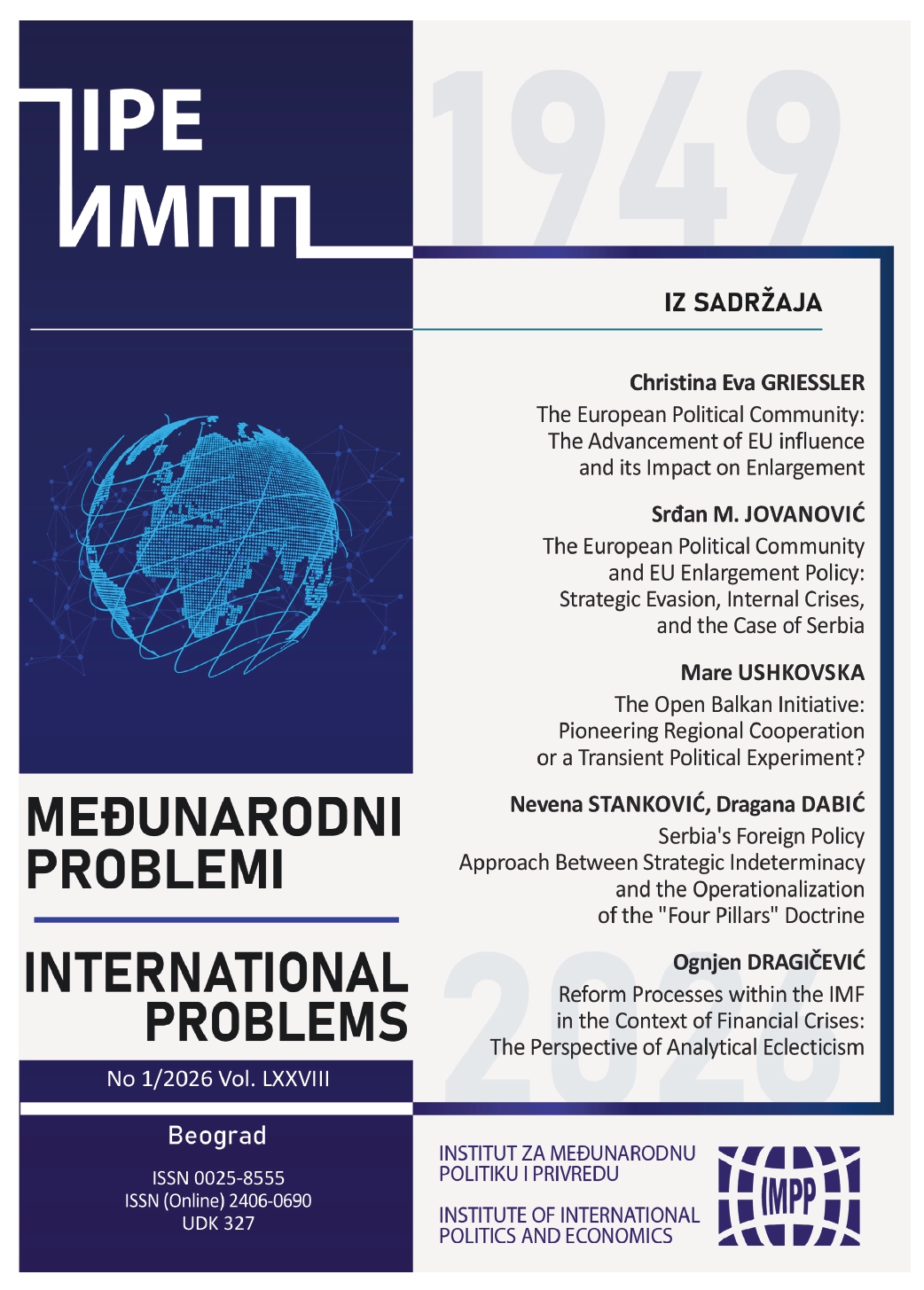
The author analyses the European Political Community (EPC) as a political platform of European states, including the EU and other partners from the EU’s wider European neighbourhood, aiming to jointly address issues of security, energy, and mobility, and a strategic foreign policy alignment. With the launch of the EPC in 2022, the argument was put forward that it could become an opportunity for giving the EU enlargement process renewed impetus by addressing the main obstacles to EU accession during informal meetings. Since Russia’s invasion of Ukraine in February 2022 and the start of Donald Trump’s second presidency of the US in 2025, the EU has faced external upheaval and new challenges. Two main questions are addressed. Firstly, is the EU using the EPC to influence partners to underline the EU’s role as an efficient foreign political actor? The second question relates to the idea that the EPC might be a useful tool to generate progress on EU enlargement, especially since political leaders from the candidate countries participate in the EPC’s meetings. The paper assesses the EU’s foreign policy role and the EU’s norm transfer capability within the EPC. The concepts of EU normative power, its strategic approach of external governance and the ideas of functional cooperation to initiate another push the accession to the EU of the Western Balkan countries are discussed in the context of the EU’s weakening actorness, which negatively impacts candidate countries’ motivation to fulfil EU conditionality. The paper suggests that the EPC is not a suitable tool to strengthen the EU’s role, as it lacks the political standing to prove that it is a reliable and credible partner for the Western Balkan countries and even for the Association Trio (Georgia, Moldova and Ukraine).
This article examines the European Political Community (EPC) as a mechanism of strategic evasion in the European Union’s enlargement policy. Launched in 2022 in response to Russia’s invasion of Ukraine, the EPC has been framed as a forum to deepen cooperation between EU and non-EU states, with some commentators suggesting it could accelerate accession. This article advances a different interpretation: that the EPC functions as a “holding bay”, designed to manage geopolitical pressure while postponing substantive commitments to enlargement. Drawing on concepts of strategic ambiguity and stabilitocracy, the article situates the EPC within the EU’s broader crisis of coherence. It demonstrates how internal contradictions (ranging from democratic backsliding in Hungary and Poland to the selective tolerance of authoritarianism in Serbia) have undermined the credibility of enlargement conditionality. The EPC institutionalizes this avoidance strategy: by offering visibility without legal obligations, it allows the EU to appear inclusive while deferring contentious debates. The Serbian case illustrates this dynamic most clearly, with Serbia’s authorities benefiting from EPC participation and EU engagement despite authoritarian practices, reinforcing stabilitocracy rather than incentivizing reform. The article concludes that the EPC mirrors the EU’s strategic paralysis: it is less a bridge to integration than a mirror of unresolved internal contradictions, offering short-term stability at the expense of long-term credibility.
The Open Balkan Initiative is an interesting case study of the effectiveness of dissemination of Schengen-like arrangements beyond the EU, particularly as a locally initiated enterprise of intergovernmental coordination. Grounded in the new regionalism theory and the tenets of international political economy, this study explores the potential and limits of such an arrangement in the Western Balkans, analyses its accomplishments, the concerns regarding its suitability for purpose, and the likely trajectory of this regional integration initiative. Through a qualitative explanatory analysis, this case study seeks to address the following central question: can Open Balkan be considered a successful regional integration initiative and, if so, to what extent? The findings show that, while there is little to differentiate Open Balkan’s ideas from previous similar multilateral initiatives, the initiative has shown faster progress in implementing its agreements compared to the Berlin Process. The study also analyses the political stigma surrounding Open Balkan and challenges some of the criticism present in previous literature. It argues that the Open Balkan’s limited membership is a strength, enabling the three member countries to implement agreements more readily, such as that on the common labour market, unburdened by many of the unresolved bilateral political disputes present in the region. Yet, the initiative is vulnerable to political cycles, as leaders’ disinterest in recent years has underscored the unclear long-term framework and sustainability of regional policy coordination between member states.
In the absence of a codified strategic document, the foreign policy orientation of the Republic of Serbia can be more clearly observed through the patterns of its positioning vis à vis leading global actors, as well as through its responses to the pressures of the international system. This paper analyzes the aspects that have been shaping Serbia’s current foreign policy approach, with the aim of identifying the dominant pattern of its strategic behavior and assessing its operational scope. Based on the identified determinants of foreign policy, the research examines how these factors determine the choice, combination and operationalization of the state’s strategic options. The central hypothesis of the paper is that over the past two decades, the hedging strategy—operationalized through the “four pillars” policy — has been profiled as the dominant pattern of Serbia’s foreign policy behavior due to its high adaptability to growing geopolitical uncertainty and shifting distribution of power. Empirical findings confirm that the combination of strategic ambiguity, selective alignment, and indirect balancing—alongside the effort to protect foreign policy autonomy and the imperative of protection territorial integrity— constitutes the operational core of Serbia’s contemporary foreign policy approach. Particular analytical attention is devoted to the issue of Kosovo and Metohija, conceptualized as a key determinant and intervening variable in understanding how Serbia operationalizes its foreign policy conduct, adapts to external pressures and defines the boundaries of its strategic orientation toward major global actors. The final section problematizes the sustainability of the hedging strategy in current international circumstances, particularly in the period following 2022. In conclusion, the article demonstrates that hedging—while functional and adaptive under conditions of multipolarity—remains strongly conditioned by the structural constraints of the international system and the unresolved status issue of Kosovo and Metohija. Together, these factors define the limits of Serbia’s foreign policy autonomy and shape the framework of its future strategic practice.
This paper aims to provide a theoretical framework to address the constraints imposed by the epistemological exclusivity of researchers, manifested in the reliance on a singular theoretical approach or a limited array of interrelated theoretical concepts in the examination of the International Monetary Fund (IMF) development. The proposed framework offers an answer to the research topic addressing the function of analytical eclecticism in providing a more thorough and accurate elaboration of reform processes inside the IMF. The principal-agent (PA) approach, the theory of bureaucratisation, and the theory of crisis exploitation may all be unified relative to the theoretical framework built on this pragmatic epistemological stance. In keeping with the aforementioned, the article outlines the functions, pertinent ideas, application strategies, and connections between different theoretical perspectives in order to provide a unified and uniform starting point for the investigation of changes inside the IMF. The suggested theoretical framework acquires more coherence and strengthens its explanatory power by incorporating the idea of the axis of concretisation and connecting points. The perception of financial crises, such as the Asian financial crisis of 1997 and the financial crises of the late first decade of the twenty-first century, as both catalysts for the initiation and implementation of institutional reforms as well as a testing ground in which these changes are realised, represents a significant component in shaping this theoretical apparatus for researching reform processes within the Fund.



 141.46 KB)