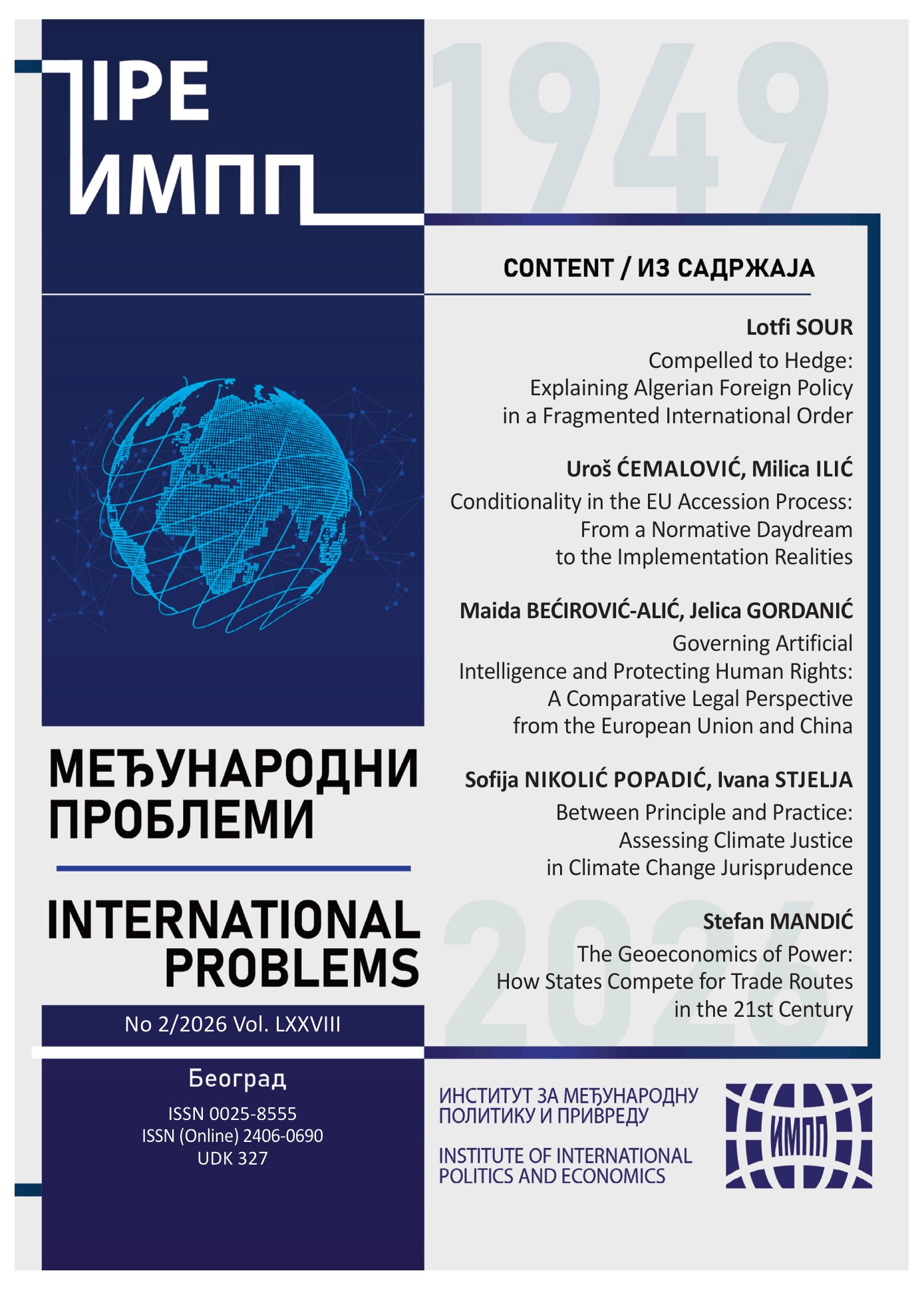
International problems Vol. 78 No. 2/2026
Content
Editorial Notes
International problems, 2026 78(2):313-316
International problems, 2026 78(2):317-367
Abstract ▼
This article reconceptualises strategic hedging as a structural constraint rather than a discretionary foreign policy choice for middle powers in an increasingly fragmented international order. While existing scholarship—concentrated predominantly in East and Southeast Asian contexts—treats hedging as an instrument of strategic flexibility, it undertheorizes the systemic conditions that render hedging a near-necessity rather than a preference. Drawing on structured interpretive case analysis of Algeria’s foreign policy across security, economic, and diplomatic domains, this article advances a probabilistic-structural argument: that the intersection of multipolar fragmentation, resource dependency, and institutionalised non-alignment generates cross-domain constraints that most parsimoniously explain Algeria’s persistent hedging posture, irrespective of leadership preferences or conjunctural variation. The analysis identifies two theoretically significant findings: an autonomy-resource paradox, in which hydrocarbon revenues simultaneously enable and constrain strategic flexibility, and a domain interdependency dynamic, in which hedging gains in one domain systematically generate constraints in another, which existing behavioural frameworks have not adequately captured. By extending structural hedging theory to a North African, Global South middle power, the article contributes to ongoing debates on middle power adaptation and the evolving architecture of a fragmented international order.
International problems, 2026 78(2):369-414
Abstract ▼
Enlargement conditionality is a cornerstone of the European Union (EU) accession process, serving as a powerful tool despite its notable inherent limitations. By analysing its role during the previous two EU enlargements (2007 and 2013), as well as in Serbia’s EU accession process, the paper explores conditionality not only as a doctrinal concept but also as a multifaceted legal-political instrument. The article’s main hypothesis is that the structural weaknesses of the conditionality principle have often led to stalemates in both political reforms and law harmonisation, widening the gap between normative objectives and implementation realities. This gap has further increased during the EU accession process of the Western Balkans (WB) countries, rendering a significant redefinition of the principle necessary. The methodological framework employed encompasses a range of approaches, including systematic and teleological analysis to elucidate the key provisions of legal acts and international treaties; content analysis for interpreting policy documents; comparative analysis to examine the evolving approaches over time; and case study methodology to provide in-depth contextual understanding. In conclusion, the authors argue for an overhaul of the conditionality principle, but also for a more straightforward and effective EU enlargement agenda, substantially adapted to the legal and political realities of candidate countries, including their capacities and political will to adopt enforceable, thoroughly prepared and truly impactful national legislation.
International problems, 2026 78(2):415-463
Abstract ▼
The global expansion of automated systems, which often operate in a nontransparent manner and beyond effective human control, opens up complex issues related to the protection of basic human rights, which represents a broader context of this research. Particular challenges arise in the field of international law, since there is no single, binding transnational normative framework that would ensure consistent protection of human rights in the digital environment. By applying the comparative law method and analyzing the content of relevant documents, this paper examines the regulatory models of the European Union and the People’s Republic of China, as the two most globally influential models of artificial intelligence management, in which liberal and illiberal concepts of human rights protection are clearly reflected, pointing to their legal-political framework, regulatory scopes and limitations. Special emphasis is placed on identifying normative gaps and risks to human rights, including privacy, non-discrimination, freedom of expression and fair treatment. The starting hypothesis of the paper is that the current international legal framework is unable to respond to the systemic challenges generated by the application of artificial intelligence, and that the divergent models of the EU and China deepen the global normative gap and prevent the establishment of universal standards for the protection of human rights. Through a critical comparison of the differences between Western liberal model and more authoritarian approach to technology management, the paper points to the urgent need to establish a globally harmonized and politically sustainable framework of international law for the regulation of AI systems.
International problems, 2026 78(2):465-513
Abstract ▼
The impacts of climate change are not evenly shared, with those least responsible often facing the gravest consequences. Therefore, climate crisis is best understood not merely as an environmental challenge, but also as a profound challenge to human rights and social equity. This article examines the concept and components of climate justice, drawing on David Schlosberg’s theoretical framework. A key research question explores the scope and depth of recognition given to climate justice in international climate agreements. The research shows that within the international legal framework, distributive justice is only partially recognised, procedural justice depends on national and complementary environmental frameworks, and justice as recognition remains largely theoretical, highlighting the role of human rights instruments. The analysis also reviews selected climate litigation cases, evaluating how distributive, procedural, and recognition-based justice are reflected in judicial reasoning. Landmark decisions by international and national courts demonstrate that states have enforceable obligations to align policies with climate objectives. The findings underscore the pivotal role of citizens and civil society in fostering climate justice through litigation, serving as key actors in holding states accountable for climate mitigation and adaptation commitments.
International problems, 2026 78(2):515-556
Abstract ▼
Global trade stands out as an important factor that influences the socioeconomic power within the world-system. As focusing on trade routes would contribute to an understanding of global power distribution, the objective is to examine how trade routes impact the formation of socio-economic power. Since the “geoeconomics of power”, which the theoretical framework is based on, represents an integration of world-systems theory and geopolitics, the article outlines how trade routes are conceptualised within these two systems of thought. The article further elaborates on the theoretical framework in which political power is understood as being dependent on economic wealth and trade routes. The main research question is how the 21st-century struggle for control over Eurasian trade routes reflects their structural significance for the reproduction of socio-economic power. The analysis concentrates on the positioning of China and Russia, vis-à-vis traditional thalassocratic core states led by the U.S. The significance of the trade routes in the premodern era and their transformation during the 19th and 20th centuries is examined first, in order to contextualize 21st century struggle over their control. The methodological approach is historical-structural and comparative. The article concludes that trade routes constitute one of the key determinants of socio-political power and that their importance for core positioning may grow in the 21st century.
Book review
Lessons of the Belgrade School of International Relations through the Life and Legacy of Henry Kissinger
International problems, 2026 78(2):557-566



 93.42 KB)